

TL;DR
- Digital asset jobs at banks pay $200K to $270K for senior roles.
- Over 60% of Fortune 500 financial firms run blockchain divisions.
- They hire finance people with blockchain knowledge, not crypto natives.
- Tokenisation, custody and ETF operations are the growth areas.
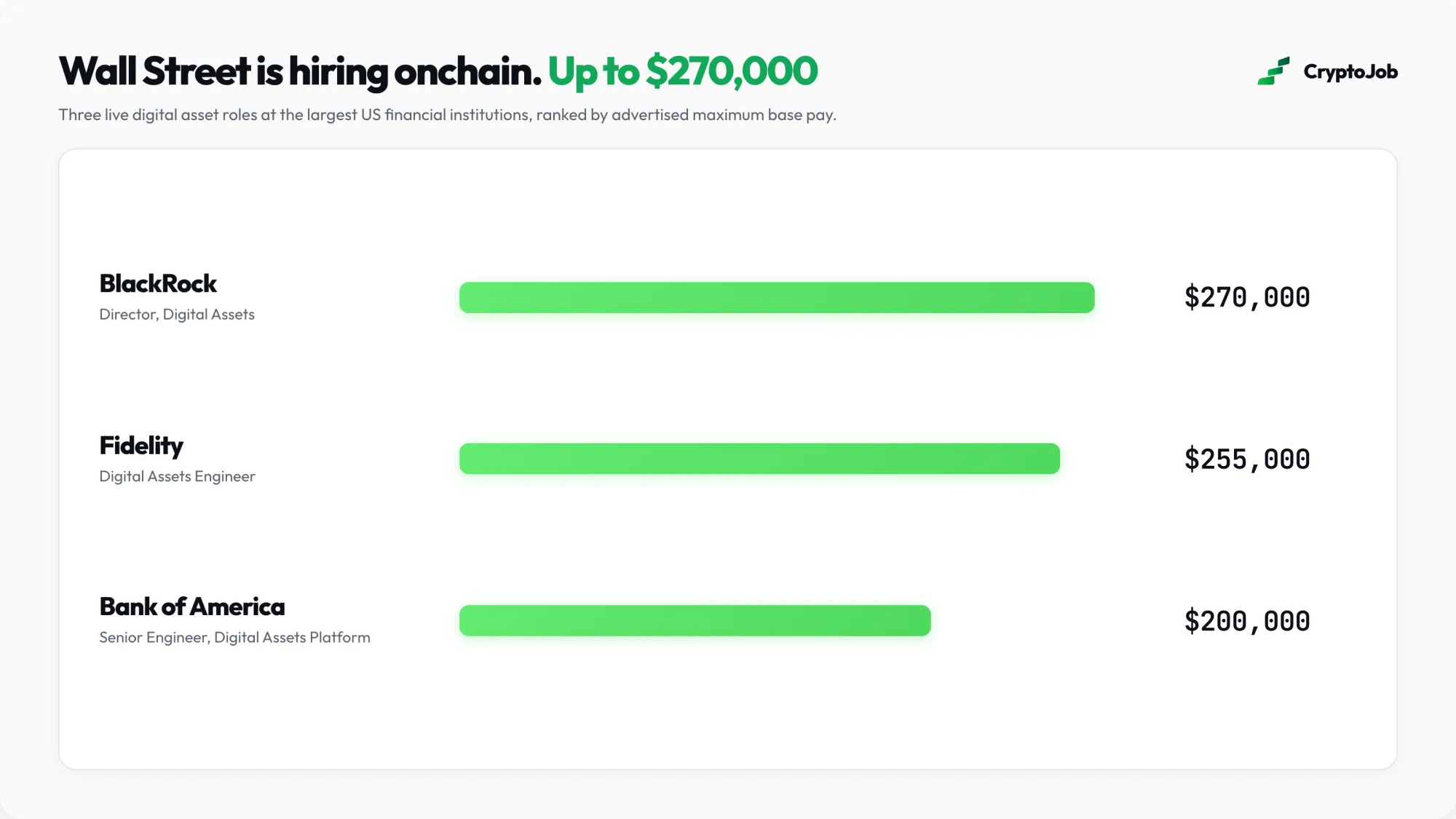
Banks are hiring for crypto, and they are paying well. BlackRock has advertised a director of digital assets at up to $270,000 before bonus. Bank of America listed a senior engineer for its digital assets platform at up to $200,000 base. Fidelity has posted an engineering role in its digital assets business paying as much as $255,000 before incentives.
These are not crypto startup jobs. They are institutional roles, and the hiring bar is different in ways that surprise people coming from a protocol background.
If you are weighing this path, browse web3 jobs to compare institutional postings against crypto native ones side by side.
Which banks are actually hiring for digital assets?
More than 60% of Fortune 500 financial firms now operate formal blockchain divisions. That includes hiring for tokenisation, blockchain based investment products and integrating digital assets with existing payment infrastructure.
The pattern is consistent across the majors: asset managers building tokenised product lines, custodians building infrastructure and banks building settlement rails.
| Function | What the role does | Typical background hired |
|---|---|---|
| Tokenisation / RWA | Brings real world assets on chain as tradeable instruments | Structured products, capital markets |
| Digital asset custody | Secures institutional holdings, key management, insurance | Security engineering, operations |
| ETF operations | Creation and redemption, market making, NAV | ETF ops, fund accounting |
| Digital asset engineering | Builds internal platforms and integrations | Backend engineering, fintech |
| Compliance and legal | Licensing, reporting, regulatory interpretation | Financial regulation, AML |
Why do banks hire differently from crypto companies?
This is the part that catches crypto native applicants out. These firms are largely seeking finance professionals with blockchain knowledge rather than blockchain people with finance curiosity.
The reasoning is regulatory. A tokenised fund still has to satisfy the same reporting, custody and disclosure rules as any other fund and someone who has never worked inside that framework is a liability regardless of how well they understand a blockchain.
So the candidate who wins is often the one who spent six years in capital markets and taught themselves Solidity on the side, not the reverse.
What does institutional crypto pay compared to protocols?
Base salaries are broadly comparable at senior level. Where they diverge is in structure.
| Bank / asset manager | Crypto native protocol | |
|---|---|---|
| Base | $200K to $270K senior | $150K to $250K senior |
| Upside | Cash bonus, sometimes RSUs | Token grants, 30 to 100% on top of base |
| Risk | Low, salary is salary | High, token value can collapse |
| Pace | Slow, committee driven | Fast, ship first |
| Job security | Strong | Cycle dependent |
The honest trade is predictability against upside. Nobody at a bank is going to make life changing money from a token that 50x's, and nobody at a protocol is going to have their role survive a two year bear market as reliably.
What skills transfer into institutional crypto careers?
If you are coming from traditional finance
Your regulatory fluency is the asset, not the obstacle. Understanding settlement, custody obligations and reporting requirements is exactly what these teams lack.
Add credible blockchain literacy on top. You do not need to write production Solidity, but you do need to explain what settlement finality means on a public chain and why it differs from T+2.
If you are coming from crypto
Learn the vocabulary of the institution. Terms like NAV, creation baskets, qualified custodian and prime brokerage will appear in the first interview and fluency signals that you can operate inside their constraints.
Be ready for a slower process, too. Institutional hiring runs months, not weeks and involves more interviews than any protocol will put you through.

Where are these roles concentrated?
New York remains the centre of gravity for asset management and ETF roles. London leads for European institutional activity, and Singapore has seen sharp growth alongside its licensing regime.
Remote is rarer here than in crypto native companies. Many of these roles sit inside regulated entities with location and supervision requirements attached, so expect hybrid at minimum.
Frequently asked questions
Do I need crypto experience to get a digital asset job at a bank?
Not necessarily. Many of these teams prioritise financial services experience and treat blockchain knowledge as trainable. Demonstrable self directed learning is usually enough at the application stage.
Are digital asset jobs at banks stable?
More stable than crypto native roles, though not immune to strategy shifts. These divisions sit inside businesses with revenue from elsewhere, which insulates them from crypto market cycles considerably.
What is a tokenisation engineer?
Someone who builds the systems that represent real world assets: funds, bonds, credit, as on chain instruments. It combines smart contract work with securities structuring, and it is one of the fastest growing institutional roles.
Do banks pay in crypto or tokens?
Almost never. Compensation is cash base plus conventional bonus, and sometimes company equity. Token grants are essentially a crypto native phenomenon.
How does the interview process differ?
It is longer and more structured, often five to eight rounds over several months, with heavier emphasis on regulatory reasoning and risk than on coding exercises.
Where to go from here
Institutional digital asset roles reward a combination most candidates do not have: regulatory grounding plus genuine blockchain understanding. Whichever side you are starting from, the gap is closable.
To see what is currently open across both institutional and crypto native employers, browse web3 jobs.