

TL;DR
- Stablecoin jobs span 1,000+ open roles across 60+ companies.
- Tether is growing headcount from 300 to roughly 450.
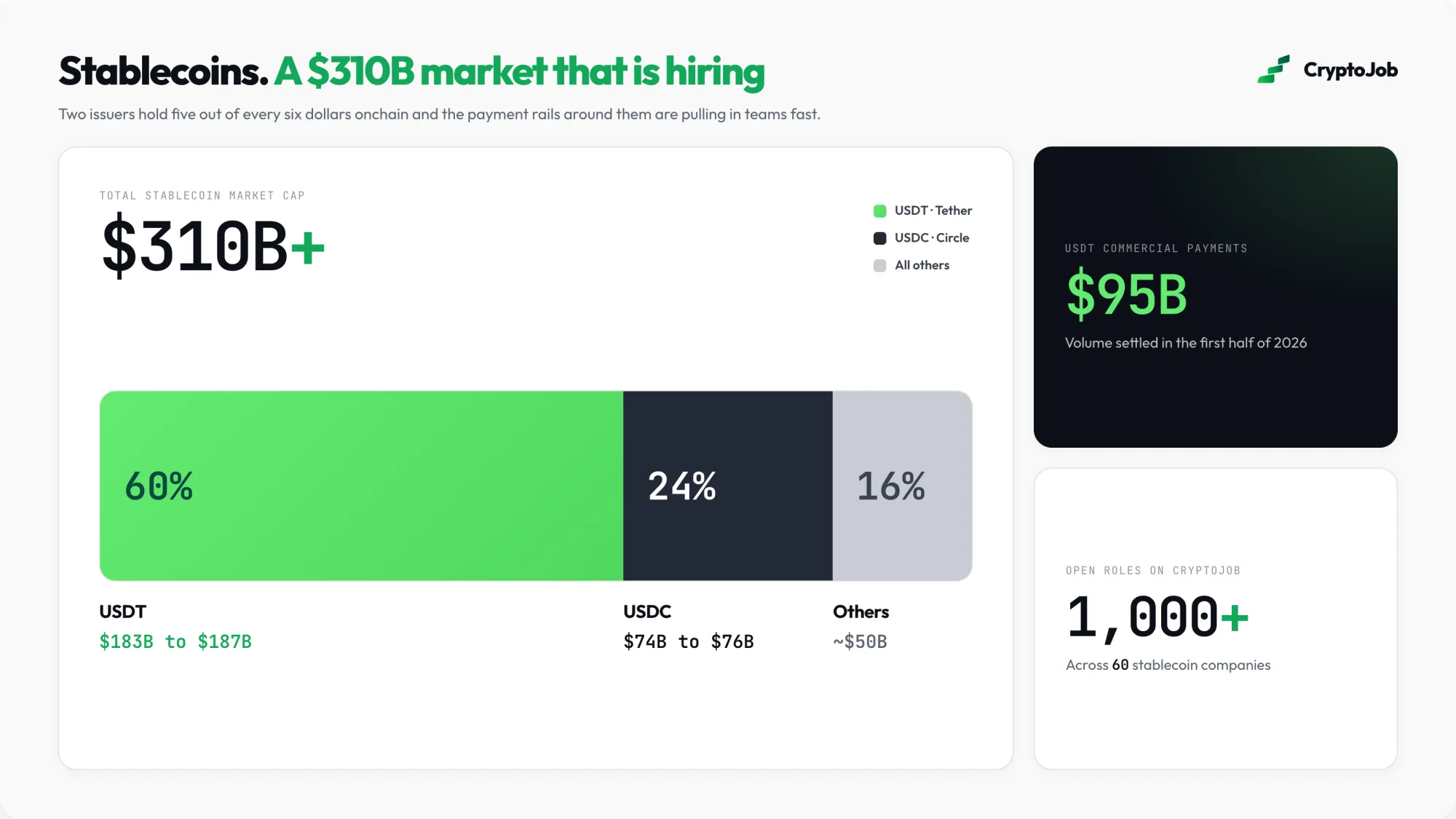
- The market sits above $310 billion, USDT holding around 60%.
- Payments and compliance experience matters more than crypto tenure.
While most of crypto shed staff in 2026, stablecoin companies did the opposite. Stablecoin jobs now span more than 1,000 open roles across 60+ companies, and the sector's two largest issuers are both in active expansion.
Tether announced plans to add 150 employees over eighteen months, lifting headcount from roughly 300 to 450, a fifty percent expansion. Circle went public in the US and has been aggressively building out global partnerships since.
If you want to see which of these roles are live, browse web3 jobs. First, why this corner is growing while the rest contracts.
Why are stablecoin companies hiring in a down market?
Because their revenue does not depend on token prices. Issuers earn from reserves and transaction volume, both of which have held up regardless of what Bitcoin has done.
Total stablecoin market capitalisation sat above $310 billion in early 2026. Tether's USDT accounts for roughly 60% at $183 to 187 billion, with Circle's USDC around $74 to 76 billion.
Usage has also split into distinct lanes. USDT has become the dominant rail for commercial payments, hitting $95 billion in the first half of 2026, while USDC remains more tightly bound to DeFi and on chain trading.
Regulatory clarity in the US and EU accelerated all of this. MiCA compliant euro stablecoins surged ahead of the July compliance deadline, opening a whole category of roles that did not exist two years ago.
What stablecoin jobs are actually open?
The mix is broader than most people expect, and heavily weighted toward functions that are not smart contract engineering.
| Function | What the work involves | Background that transfers |
|---|---|---|
| Payments infrastructure engineering | Microservices and APIs moving value across chains and banking rails | Fintech backend, payments systems |
| Stablecoin operations | Issuance, settlement, treasury ops, reconciliation | Payment operations, treasury |
| Compliance and policy | VASP licensing, regulator engagement, jurisdiction expansion | Financial regulation, AML |
| Capital markets legal | Agreements with exchanges, market makers, custodians | Fintech or securities law |
| Regional business development | Market entry, partnerships, local regulatory coordination | Payments BD, fintech partnerships |
| Product management | Issuance products, merchant tooling, settlement flows | Fintech product, payments |
Notice how many of those columns say "payments" rather than "crypto." That is the defining characteristic of this hiring market.
Who is hiring, and for what?
Tether
Tether's expansion marks a deliberate shift away from an unusually lean operating model. Most of the new roles are technical, with heavy emphasis on engineers building what the company describes internally as a broad technology stack spanning digital finance, telecommunications and infrastructure.
It is also strengthening governance. A new chief financial officer was appointed, with London becoming a key operational hub for finance, risk and compliance functions.
Circle
Circle's openings skew toward payments infrastructure and regulated expansion. Engineering roles centre on building and maintaining systems that move value across both blockchain and banking protocols.
Its regional hiring is worth watching. A senior growth role targeting Sub-Saharan Africa asked for fourteen plus years in business development, fintech or payments, the kind of requirement that signals a company building a regulated business rather than chasing retail crypto users.
Traditional finance entrants
The most significant signal may be from outside crypto entirely. Vanguard, historically among the more sceptical major asset managers, began hiring a head of digital assets to oversee tokenisation, stablecoins and blockchain infrastructure.
Western Union has moved into regulated stablecoin issuance for remittances. When incumbents of that size start building, the hiring follows.
What background do stablecoin employers actually want?
This is where candidates most often misjudge the market. Crypto native experience is helpful but rarely the deciding factor.
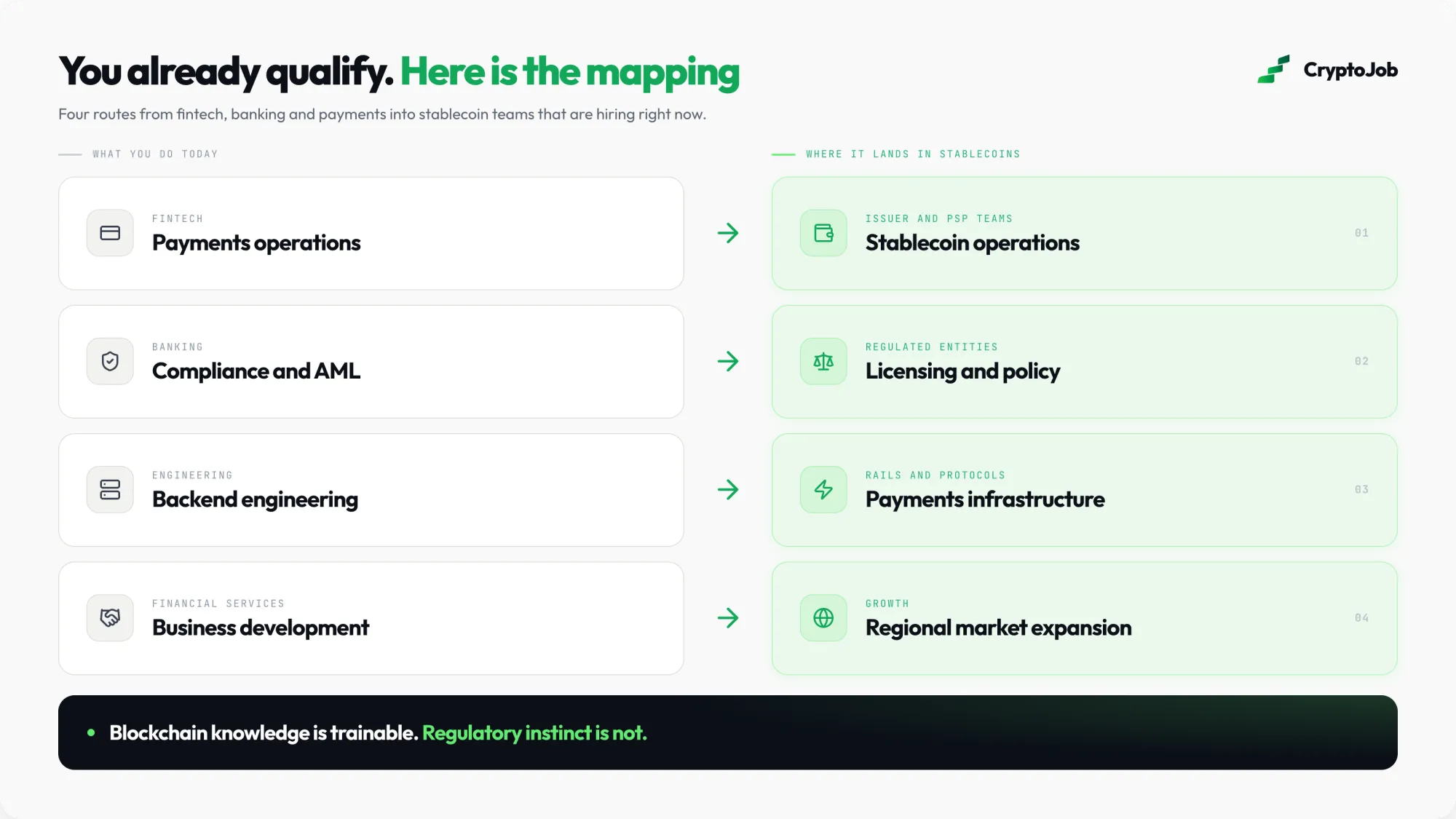
Stablecoin issuers operate as regulated financial businesses. They need people who understand settlement, reconciliation, reserve management, licensing and AML, because those are the functions that determine whether the business survives contact with a regulator.
A payments operations manager from a fintech with no blockchain background is often a stronger candidate than a DeFi contributor with three years on chain. The blockchain half is learnable; the regulatory instinct is not, at least not quickly.
Where are stablecoin jobs concentrated geographically?
More widely spread than most of crypto, because the businesses need local regulatory presence in each market they operate.
London has become a significant hub for finance, risk and compliance functions. New York anchors US regulatory and capital markets work. And emerging markets are seeing genuine hiring rather than token representation: Africa, in particular, where currency volatility and remittance flows have driven real stablecoin adoption.
That geographic spread is good news if you are outside the traditional crypto hubs. A payments background in Nigeria, Kenya or Southeast Asia is directly relevant to companies actively expanding into those markets.
Is this a safer bet than the rest of crypto?
On the evidence of 2026, meaningfully so. While exchanges and protocols cut thousands of roles, stablecoin issuers expanded.
The caveat is regulatory concentration risk. These businesses are far more exposed to legislative change than to market cycles, and a hostile turn in a major jurisdiction would hit hiring quickly.
But the underlying activity, moving dollars across borders faster and cheaper than legacy rails, has demand independent of crypto sentiment. That is a genuinely different risk profile from a DeFi protocol.
Frequently asked questions
How many stablecoin jobs are available?
Over 1,000 roles across more than 60 companies in stablecoin infrastructure, payments and on chain finance, according to sector specific job boards tracking the space.
Do I need blockchain experience for stablecoin jobs?
Often not. Many roles prioritise payments, compliance or fintech operations experience, treating blockchain knowledge as trainable. Engineering roles are the main exception.
Which stablecoin companies are hiring most?
Tether is adding around 150 roles over eighteen months. Circle is expanding post IPO across engineering, legal and regional business development. Traditional institutions including Vanguard and Western Union have also begun building teams.
Are stablecoin jobs more stable than other crypto roles?
They have proven more resilient through 2026, since issuer revenue derives from reserves and transaction volume rather than token prices. The primary risk is regulatory rather than market driven.
Where are stablecoin companies hiring geographically?
London for finance and compliance, New York for regulatory and capital markets and increasingly emerging markets across Africa and Asia where adoption is growing fastest.
Where to go from here
Stablecoins are the part of crypto that most resembles a conventional financial business, which is exactly why the hiring held up when everything else did not.
If your background is payments, compliance or fintech operations, you are closer to qualified than you probably think. Browse web3 jobs to see what is currently open.