

TL;DR
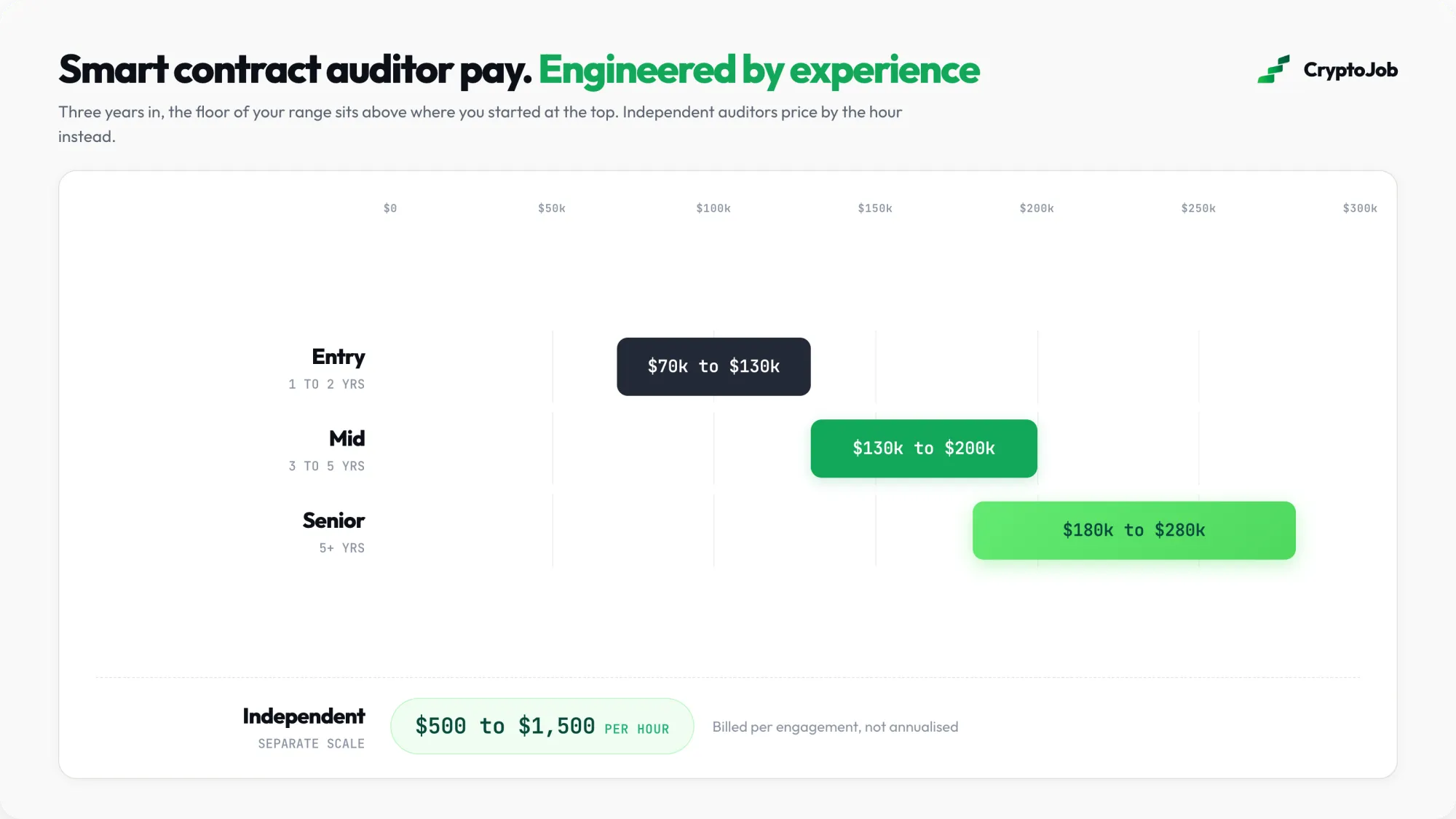
- A smart contract auditor salary runs $70K to $130K entry, $130K to $200K mid, $180K to $280K senior.
- No audit firm publishes pay bands. Anyone quoting exact firm figures is guessing.
- Top contest auditors clear $200K to $700K a year.
- Independent researchers charge $500 to $1,500 an hour.
The short answer: a smart contract auditor salary in 2026 sits between $70,000 and $280,000 depending on seniority, with mid level auditors clustering around $130,000. Independent researchers and top contest performers earn considerably more.
What you will not find anywhere, including here, is a verified figure for what Zellic, Trail of Bits, OpenZeppelin or Spearbit specifically pay. None of them publish compensation bands. What we can do is show you the market rates these firms compete within, and explain how their business models change the offer you are likely to receive.
If you are actively looking, browse web3 jobs to see what security roles are currently open and what they disclose.
How much does a smart contract auditor make in 2026?
Security auditing is one of the highest paid specialisations in software engineering, and the gap between a junior and a senior is unusually wide.
The reason is scarcity. A protocol holding half a billion dollars in immutable code cannot patch its way out of a critical vulnerability, so the people who find those bugs before attackers do command a premium.
| Level | Experience | Base range (USD) | Typical extras |
|---|---|---|---|
| Entry | 1 to 2 years | $70K to $130K | Rarely tokens |
| Mid | 3 to 5 years | $130K to $200K | Performance bonus |
| Senior | 5+ years | $180K to $280K | Bonus plus token participation |
| Independent | Reputation led | $500 to $1,500/hr | Engagements $25K to $300K |
One number worth ignoring: general job aggregators sometimes list ranges starting near $23,000. Those datasets are heavily skewed toward junior and low cost of living submissions and do not reflect what audit firms actually pay.
Do audit firms publish their salaries?
No. Not one of the major firms discloses compensation bands publicly, and most do not list salary on their job postings either.
This matters because a lot of content claims otherwise. If an article tells you a specific firm pays a specific number, ask where that came from, it is almost always a market average relabelled with a company name attached.
What you can verify is the shape of each firm's business, which tells you a great deal about how they structure offers.
What is the difference between Zellic, Trail of Bits, OpenZeppelin and Spearbit?
These four are not competing for the same engineer in the same way. Their models differ, and so does the career each one offers.
| Firm | Model | What that means for you |
|---|---|---|
| Trail of Bits | Established security consultancy, broad scope beyond crypto | Structured levels, traditional employment, work spans blockchain and conventional security |
| OpenZeppelin | Audit practice attached to widely used contract libraries | Deep Solidity focus, your work touches standards the whole ecosystem uses |
| Zellic | Research led boutique with a strong public findings record | Smaller team, higher visibility per engineer, reputation compounds fast |
| Spearbit | Marketplace connecting independent researchers to protocols | Not salaried employment, you operate as a contractor and set your own rate |
That last row is the one people miss. Spearbit is structurally different from the other three, so comparing its "salary" to theirs is a category error.
Is a blockchain security engineer salary better at a firm or independently?
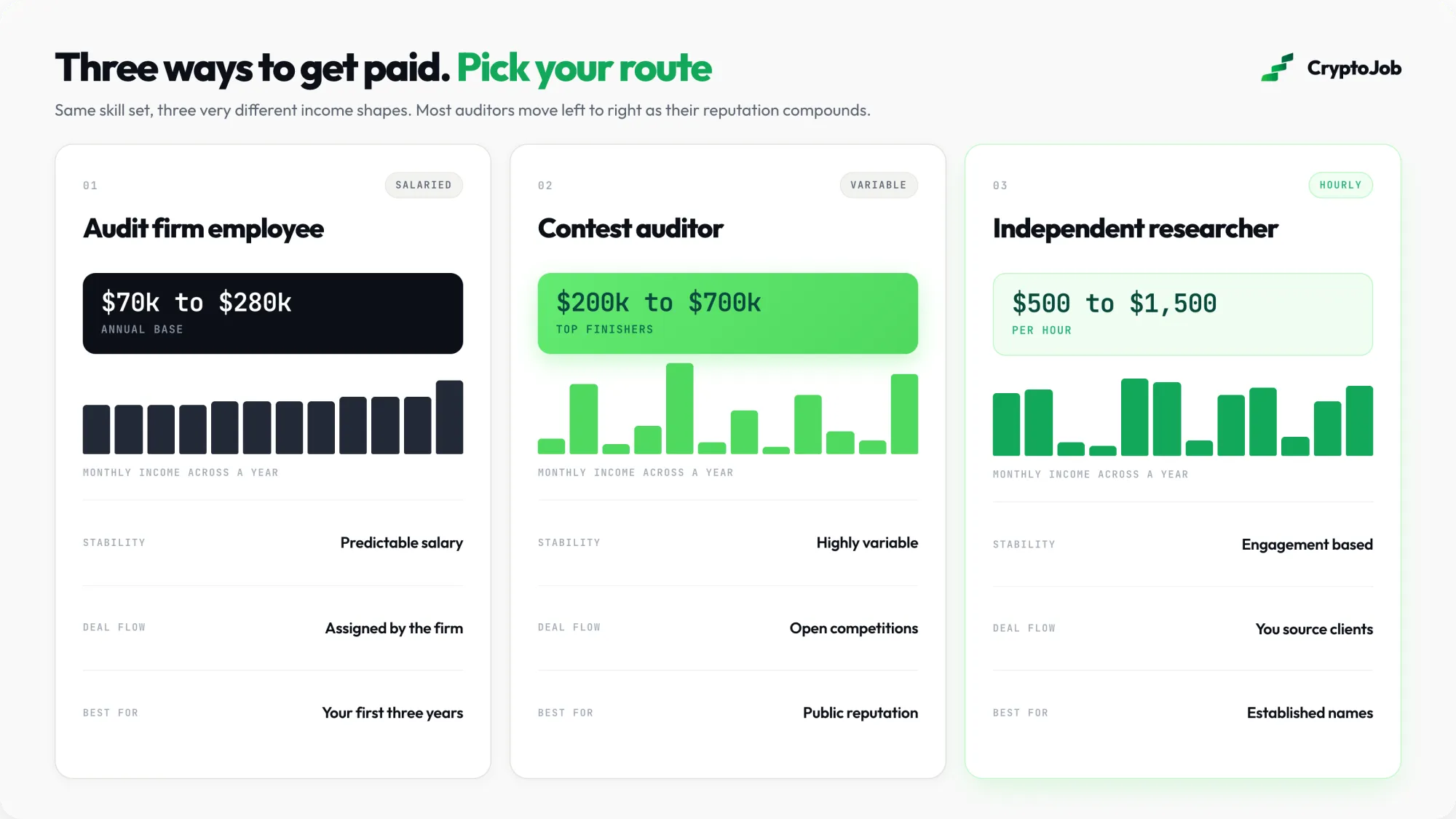
Firm employment buys you stability, mentorship and a pipeline of work you did not have to win yourself. That is worth a great deal early on.
Independent work pays more per hour and scales with reputation rather than tenure. Senior independent researchers charge $500 to $1,500 hourly, with individual engagements running from $25,000 to $300,000 depending on protocol complexity.
Contest platforms sit somewhere between the two. Top finishers publicly disclose $200,000 to $700,000 a year in contest winnings, and many layer private retainers worth another $100,000 to $400,000 on top.
The catch is variance. Contest income is lumpy and reputation gated, and most participants earn a fraction of what the leaderboard suggests.
What actually moves a smart contract auditor salary?
Does location still matter for web3 security jobs?
Less than it used to, but yes. North American employers still set the top of the market, and European and Singapore based firms pay competitively.
Remote global roles have compressed the gap considerably, though. Several US banded protocols now pay close to parity regardless of where you sit.
Which skills carry a premium?
Specialisation beyond mainstream Solidity is the clearest lever. Formal verification, zero knowledge circuits, Rust on Solana, Move on Sui and Aptos and CosmWasm on Cosmos chains all command higher rates because the talent pool is genuinely small.
Public findings matter more than credentials. One well documented critical vulnerability does more for your rate than any certification.
How do you get your first audit role?
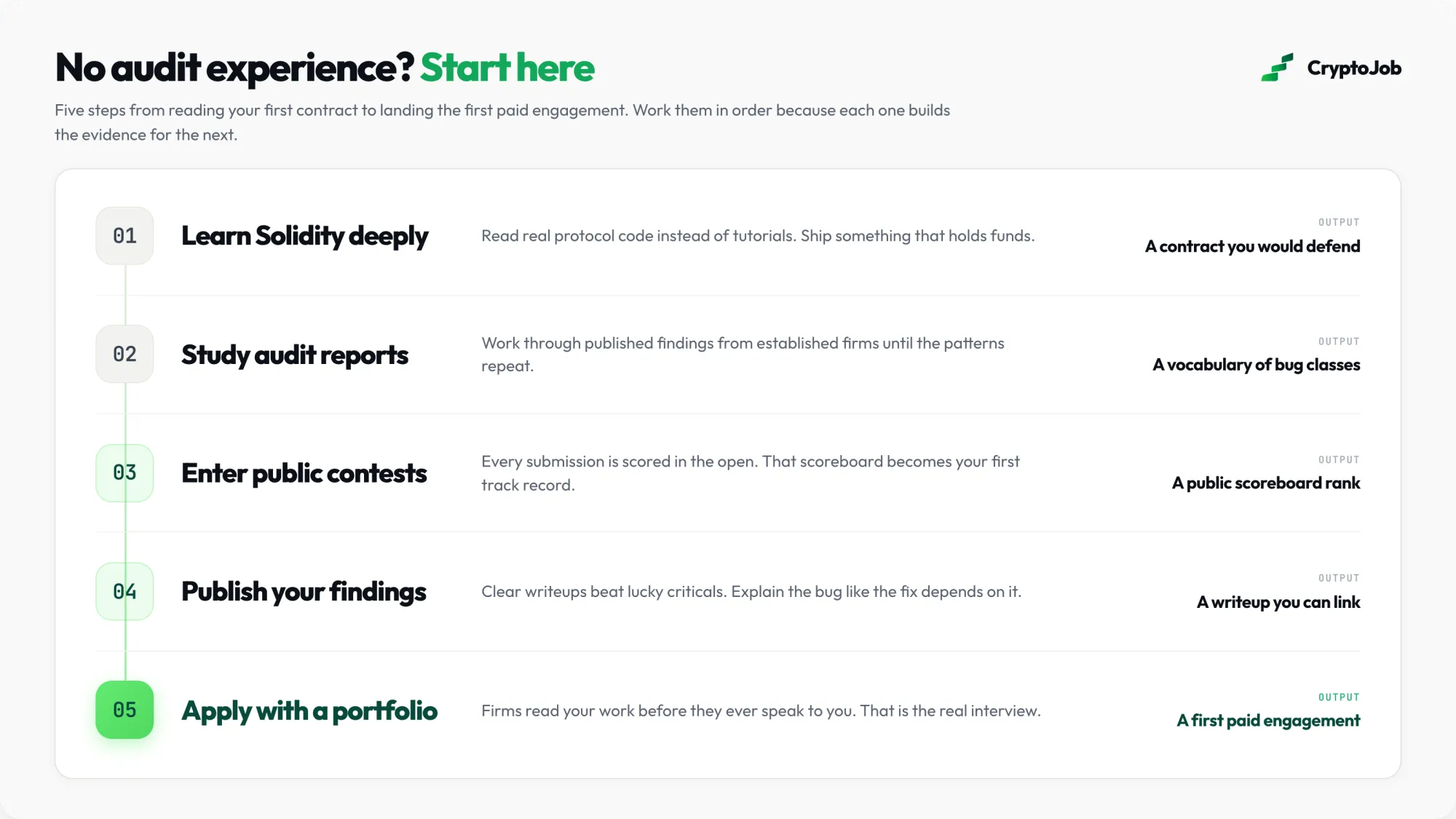
The entry path is unusual in that it rewards demonstrated output over interviews. Firms hire people whose public work they have already read.
Start with public contests, where every submission is scored transparently. Write up your findings properly, because a well explained medium severity bug signals more than a lucky critical.
Then read audit reports from the firms you want to join and understand their house style. Their reports are public, and matching how they think about severity is half the interview.
Frequently asked questions
What is the average smart contract auditor salary?
Mid level auditors average around $130,000 base. The full time range spans roughly $70,000 at entry to $280,000 for senior auditors at established firms, before tokens or bonuses.
Can you become an auditor without a computer science degree?
Yes. Audit hiring is portfolio driven, public contest results and published findings carry more weight than formal qualifications. Several well known auditors came from self taught backgrounds.
Do audit firms pay in tokens?
Sometimes, usually at senior level and usually as a supplement rather than a replacement for base salary. Firms that audit many protocols tend to pay cash to avoid conflicts of interest.
How long does it take to reach a senior auditor salary?
Typically five years or more in traditional employment. Contest platforms compress that timeline considerably for people who perform well, since reputation is public and transferable.
Is smart contract auditing still in demand in 2026?
Yes. Security roles remain among the hardest for crypto companies to fill, and demand has held steadier than most other web3 job categories through market cycles.
Where to go from here
If you are targeting a security role, the fastest route is public output, contests, writeups and a portfolio a hiring manager can read before speaking to you.
When you are ready to look, browse web3 jobs for current openings across audit firms, protocols and security teams.